Colophon from a book produced by mimeograph, Philosophische Fragmente by Max Horkheimer and Theodor W. Adorno, New York: Institute of Social Research, 1944. (Courtesy of the rare book collection at J. Murrey Atkins Library, University of North Carolina at Charlotte)Edison Rotary Mimeograph, No. 17, 1906–1930. (Courtesy of the collections of The Henry Ford, 30.1431.6)n.an apparatus for document duplication that employs the stencil processYates 1989, 70New duplicating processes removed a technological and financial barrier by creating a range of inexpensive options suited to these needs, from carbon paper for a few copies to mimeograph for hundreds. Printing remained a practical option when thousands of copies were needed.Batterham 2008, 59Somewhat later, in 1881, Edison also patented a version of the trypograph process that was picked up by the A. B. Dick Company of Chicago and marketed under the name Mimeograph . . . The Mimeograph and the Trypograph were both sold as complete copying systems. Both came in a wooden box, which included the file-surfaced writing plate, a hinged frame to hold the stencil, and a flat-bed or printing board. The boxes also contained an ink roller, an inking slate, ink, varnish and a brush for making corrections, waxed stencil paper, blotters and a writing stylus.Dana 2021, 13Mimeographs, like spirit duplicators, began as flat single-page duplicators very similar to a modern silk-screen press. They later evolved into a self-feeding drum printer. Unlike the “Ditto” machine, mimeos use a waxy master sheet that allows ink to pass through after being drawn or typed upon. The impact of the typewriter or pencil displaces the wax, but leaves the fine paper fibers in place, creating a stencil. Mimeo offers a broader range of color choices and can print many more copies than the spirit method. This is because the mimeograph uses ink, which can be replenished, unlike the hecto and spirit duplicator, which rely on single-use application of aniline dye.a copy produced using a mimeographHawley 2014, 42–43The ease of access to mimeography across the printing industry, business offices, and community organization settings blurred boundaries for the social production of print. Accessible and localized, this form of self-publication connoted rejection of external control over a community’s message and production of self-determined cultural content. Though such practices were not exclusive to amateur producers or underground presses, mimeographs have become the stuff of legends for those studying alternative publishing or the Mimeo Revolution. From the Black Arts Movement to feminist presses, mimeography linked marginalized groups to a recurring motif of independence and aided in the construction of community.NARA 2023bResearch shows that mimeographs can be stable if they were created on non-acid paper. If the document is brittle or highly discolored, consider reformatting through digitization or copying.
Notes
Mimeograph (or mimeo) has become a generic term, used to describe any stencil duplicating machine, process, or product. The original Mimeograph was invented in the late 1880s by the A. B. Dick Company and Thomas Edison. It originally employed a flat bed, but a machine with a rotating drum was quickly introduced and became extremely common in business settings, community organizations, and some professional print shops until tapering off in the 1970s. Although the mimeograph process is often confused with spirit duplication (ditto), mimeo works by forcing ink through a stencil rather than transferring a small layer of pigment from a master. Since the ink is replenishable, more copies can be made from each master with a mimeograph than a spirit duplicator. The ink can be in a range of colors but is often black and is fairly stable.

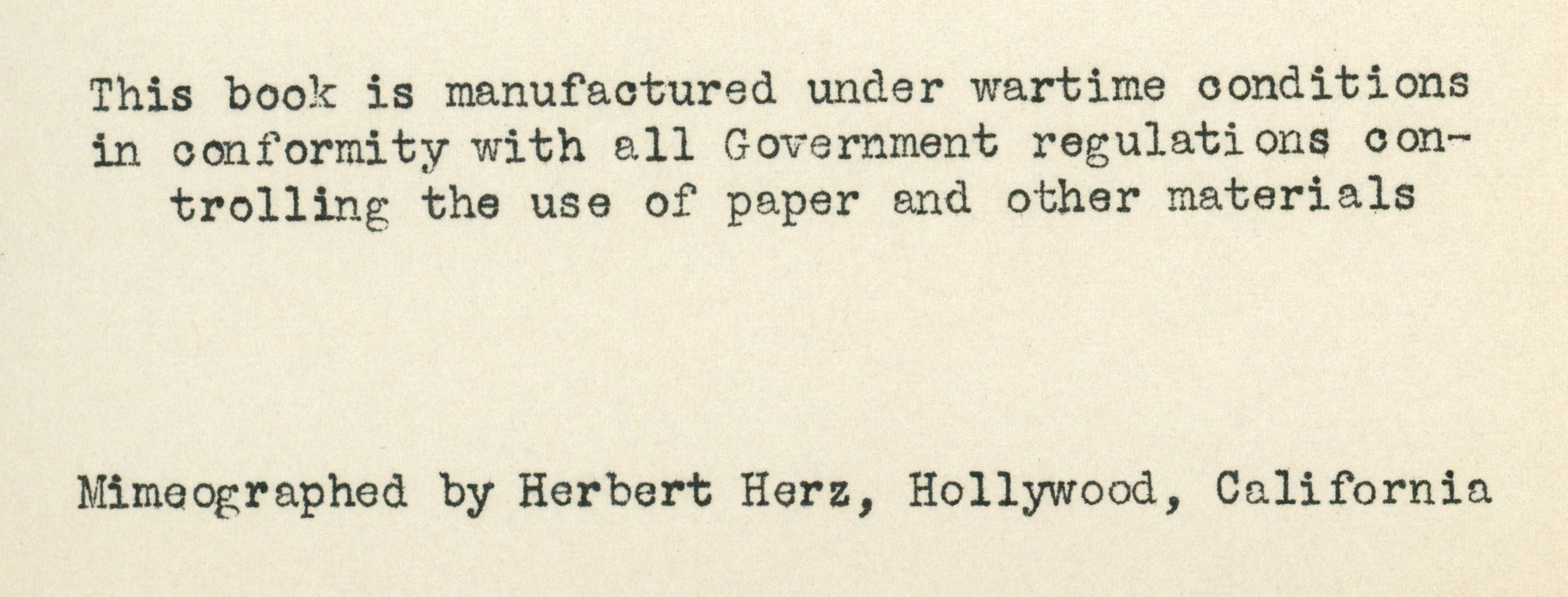 Colophon from a book produced by mimeograph, Philosophische Fragmente by Max Horkheimer and Theodor W. Adorno, New York: Institute of Social Research, 1944. (Courtesy of the rare book collection at J. Murrey Atkins Library, University of North Carolina at Charlotte)
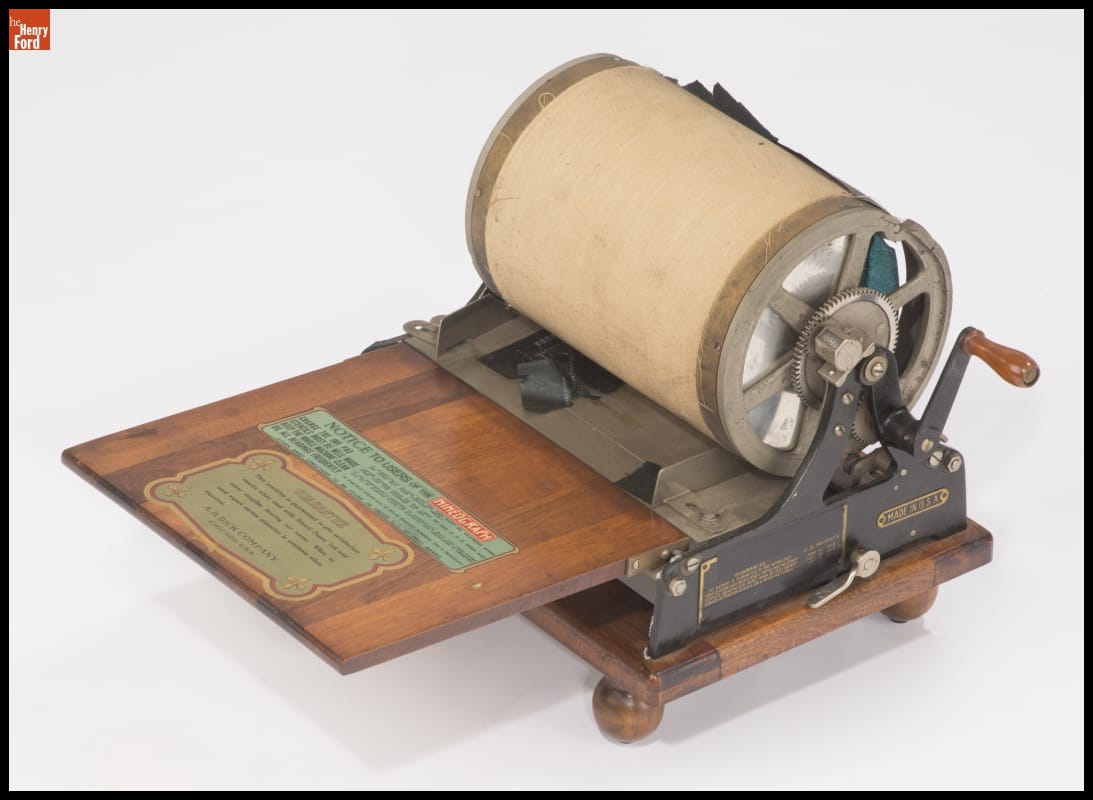 Edison Rotary Mimeograph, No. 17, 1906–1930. (Courtesy of the collections of The Henry Ford, 30.1431.6)
n.
an apparatus for document duplication that employs the stencil process
a copy produced using a mimeograph
Edison Rotary Mimeograph, No. 17, 1906–1930. (Courtesy of the collections of The Henry Ford, 30.1431.6)
n.
an apparatus for document duplication that employs the stencil process
a copy produced using a mimeograph